
Cash Flow Reality
Compare appreciation narratives against current rental math.
Austin buyers often need to sanity-check hold assumptions against actual rent, expense pressure, and financing fit before spending time on a deeper model.
PropertyIQ AI
Single-property intelligence workspaceAI Property Analysis Software in Austin, TX
Analyze any Austin, TX property address with AI to review value, rent, DSCR, tax history, transfer context, and lender-fit signals in one workflow.
Try the live demo without signing in.Why Austin
PropertyIQ AI gives Austin, TX investors, agents, and lending teams one workflow for property record review, tax context, leverage screens, and first-pass investment judgment before full underwriting begins.
Cash Flow Reality
Austin buyers often need to sanity-check hold assumptions against actual rent, expense pressure, and financing fit before spending time on a deeper model.
Tax Context
Assessment and tax context change deal quality quickly, so Austin screening works better when those numbers sit next to value and rent assumptions from the start.
Lender Fit
Use one Austin address to quickly see whether the file looks financeable, borderline, or not worth escalating to manual underwriting.
Austin Market Data
This view compares Austin home values, long-term rent, and short-term rental pricing as indexed trend lines
so the page keeps one readable chart instead of three conflicting cards.
Indexed Trend View
Home value
$425k +52.4% vs. 2016 baseline Source: Zillow ResearchLong-term rent
$1,563 +29.3% vs. 2016 baseline Source: Zillow ResearchAirbnb nightly price
$135 -6.9% vs. first public snapshot Source: Inside AirbnbAustin home value and long-term rent lines use annual Austin metro points sampled from Zillow time series. Airbnb uses recent Austin snapshots from 2024 Q2 through 2025 Q3, so it is shown as a directional comparison rather than a full decade index. Updated April 11, 2026 with Zillow Research and Inside Airbnb public data.
Austin Search Demand
Instead of repeating a generic city template, this page targets Austin rental property analysis, Austin DSCR screening, Austin property tax research, and Austin short-term rental feasibility in one indexable market page.
Austin rental analysis
This page is written for buyers searching Austin rental property analysis, Austin investment property calculator workflows, and Austin deal screening before they open a full spreadsheet.
Austin DSCR screen
Austin investors and lenders frequently need an early read on DSCR, leverage, debt yield, and break-even pressure. The city page surfaces those questions directly instead of forcing a generic metro summary.
Austin tax + appraisal
Search demand around Austin property taxes, Travis County appraisal values, and assessed value drift is usually tied to acquisition risk, so this page keeps tax context next to rent and valuation assumptions.
Austin Official Sources
Backlinks do not come from code alone, but pages earn them more easily when they consolidate the official Austin sources that investors, reporters, and local partners already use.
Market data
The Austin trend chart is built from Zillow Research time-series data and Inside Airbnb public snapshots so the page can be cited as a source-backed market overview rather than a generic sales page.
Tax records
Austin underwriting quality depends on verified appraisal and exemption context, so linking to Travis Central Appraisal District helps buyers, brokers, and writers validate the tax side of the memo.
STR compliance
Austin STR demand is neighborhood-specific and regulation-sensitive. Linking to the City of Austin licensing and hotel occupancy tax pages makes this page more useful for operators, journalists, and local partners.
Austin Investor Signals
Austin investors are usually balancing post-run-up price expectations, Texas tax pressure, neighborhood-by-neighborhood short-term rental fit, and suburban rental demand that does not behave the same way across the metro.
Urban Core
Downtown, East Austin, and close-in neighborhoods can still support premium rents, but acquisition teams need to underwrite today’s lease-up and expense reality rather than rely on peak appreciation momentum.
Suburban Demand
Many Austin-area investors are screening for school-district demand, newer housing stock, and lower turn risk in suburban corridors where long-term occupancy can be steadier than trendier short-term pockets.
Tax + Insurance
Texas property tax load, reassessment risk, and rising insurance assumptions can change DSCR and break-even occupancy fast, so those inputs need to sit beside rent and leverage from the beginning.
STR Reality
Austin investors screening Airbnb or furnished rental plays still need to separate convention-driven or event-driven demand pockets from neighborhoods where regulation, seasonality, or turnover can break the model.
Austin Workflow
Rent vs. Price
Compare projected rent and monthly cash flow against current valuation assumptions.Tax Burden
Review assessed value and property tax context before committing to a hold scenario.Equity & Leverage
Use lien and value context to understand how much room the deal actually has.Decision Speed
Move from one Austin address to a defendable first-pass decision in minutes.Example Workflow
Enter an Austin address, review the property record, scan tax and ownership context, compare projected scenarios, and use the lender screen to decide whether the deal deserves full underwriting or should be filtered out early across Central Austin, East Austin, Round Rock, Cedar Park, and surrounding submarkets.
Step 1
Step 2
Step 3
Austin FAQ
Austin FAQ
These answers are written for Austin investors, brokers, and lending teams who need more than a generic city template before deciding whether a property is worth deeper underwriting.
Austin FAQ
Start with the Austin page to review assessed value, tax burden, ownership context, lien pressure, long-term rent benchmarks, and a first-pass lender screen before you spend time on a full spreadsheet model.
Austin FAQ
Austin investors usually need to check current valuation versus rent support, property tax load, insurance sensitivity, and whether the leverage still works after today’s financing costs rather than peak-market assumptions.
Austin FAQ
Yes. The Austin workflow is designed to keep rent assumptions, expense pressure, DSCR, debt yield, and scenario comparisons in one address-level view so teams can decide faster whether a deal deserves deeper underwriting.
Austin FAQ
It gives Austin investors, brokers, and lenders one screen for parcel facts, taxes, transfers, leverage, rent benchmarks, and scenario analysis so they can move from a raw address to a defendable hold, refinance, or pass decision.
Austin FAQ
Austin behaves differently from many large metros because rent growth, post-2021 price cooling, suburban demand pockets, and Texas tax pressure all affect the first-pass decision. A generic city page misses those market-specific tradeoffs.
Austin FAQ
It can be, but the answer is deal-specific. Buyers typically need cleaner basis, realistic rent assumptions, and tighter expense discipline than they did during the run-up, especially if they want the property to clear lender thresholds on current rates.
Austin FAQ
Start with the Travis Central Appraisal District property record to verify assessed value, exemptions, and appraisal history, then compare that tax context against current rent and financing assumptions before deciding whether the deal still works.
Austin FAQ
Use the City of Austin short-term rental program and hotel occupancy tax pages first. Austin STR licensing, tax reporting, and local operating requirements can change deal feasibility even when nightly pricing looks attractive.
Austin FAQ
For Austin housing and rent benchmarks, cite Zillow Research. For public short-term rental pricing snapshots, cite Inside Airbnb. For appraisal and tax context, cite Travis Central Appraisal District. For STR compliance, cite the City of Austin licensing and tax guidance.
Inside the Product
The middle of the workflow is no longer a passive demo clip. These product views show the actual screens Austin, TX investors and lenders use to pressure-test assumptions and read the property fast.
Try the live demo without signing in.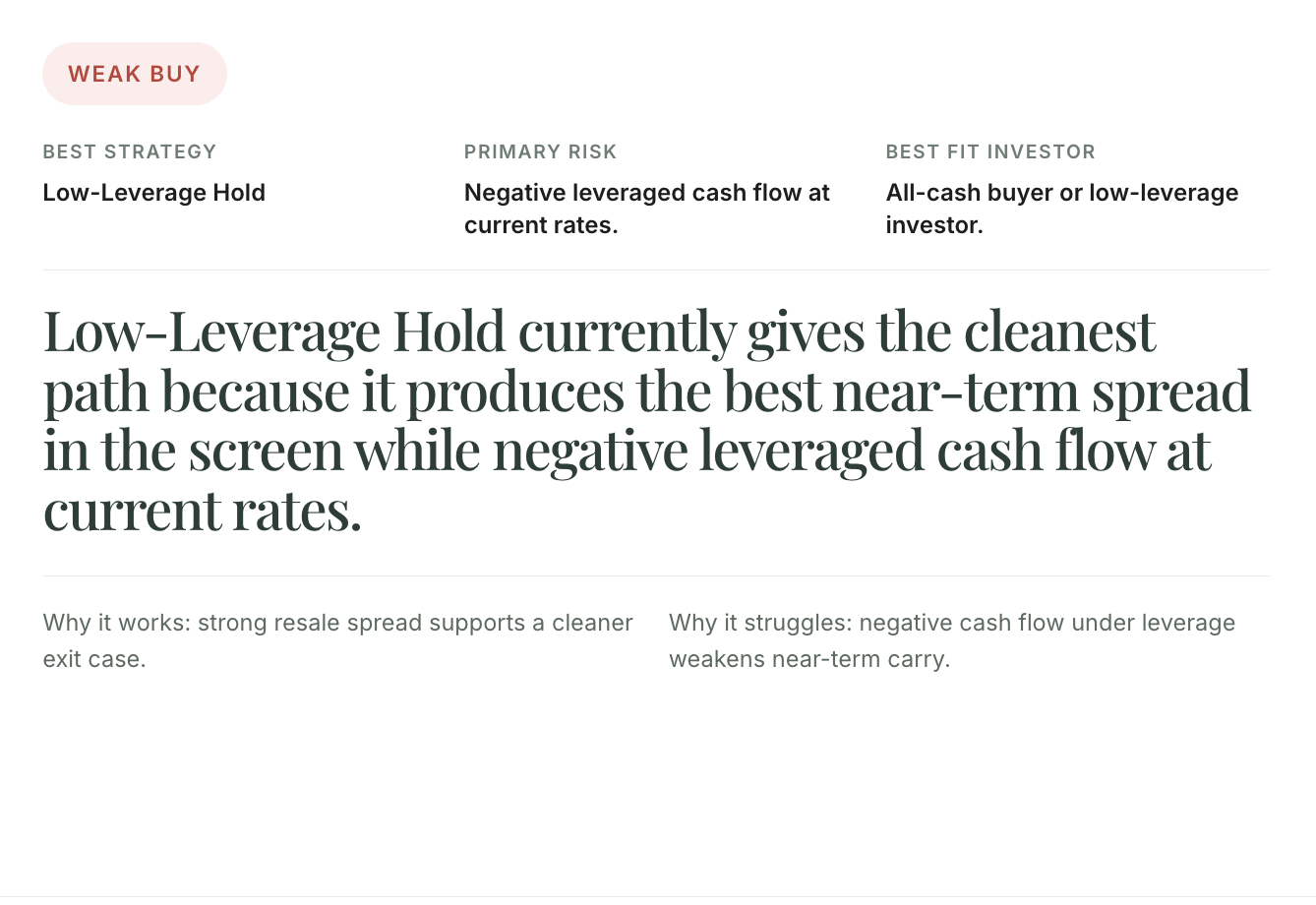
Investment Verdict
The verdict layer surfaces the best strategy, the key risk, and the right investor fit so teams can move from raw data to a defendable property call faster.
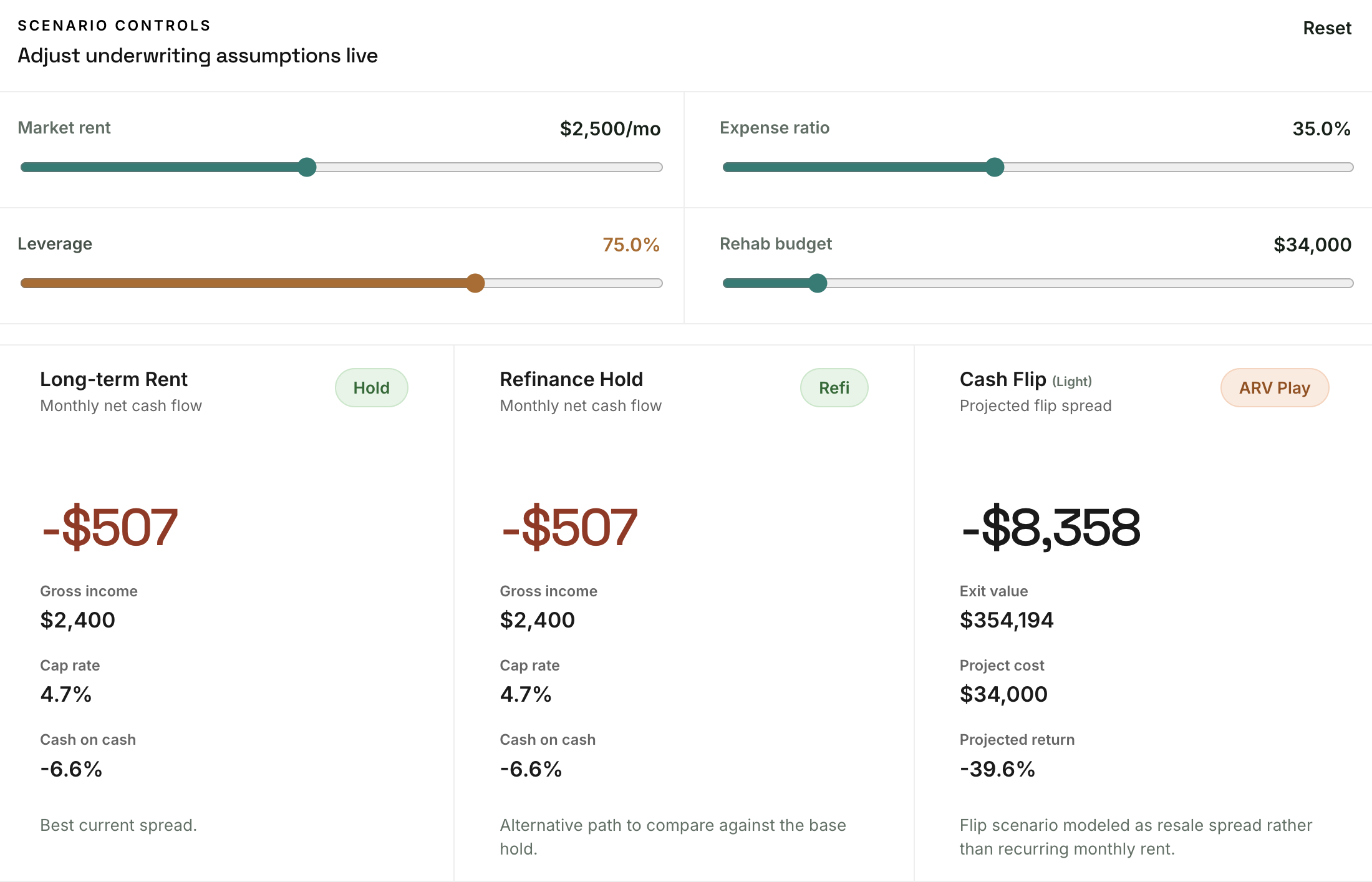
Scenario Controls
Pressure-test hold, refinance, and flip paths from one underwriting surface instead of rebuilding spreadsheet assumptions every time the deal changes.
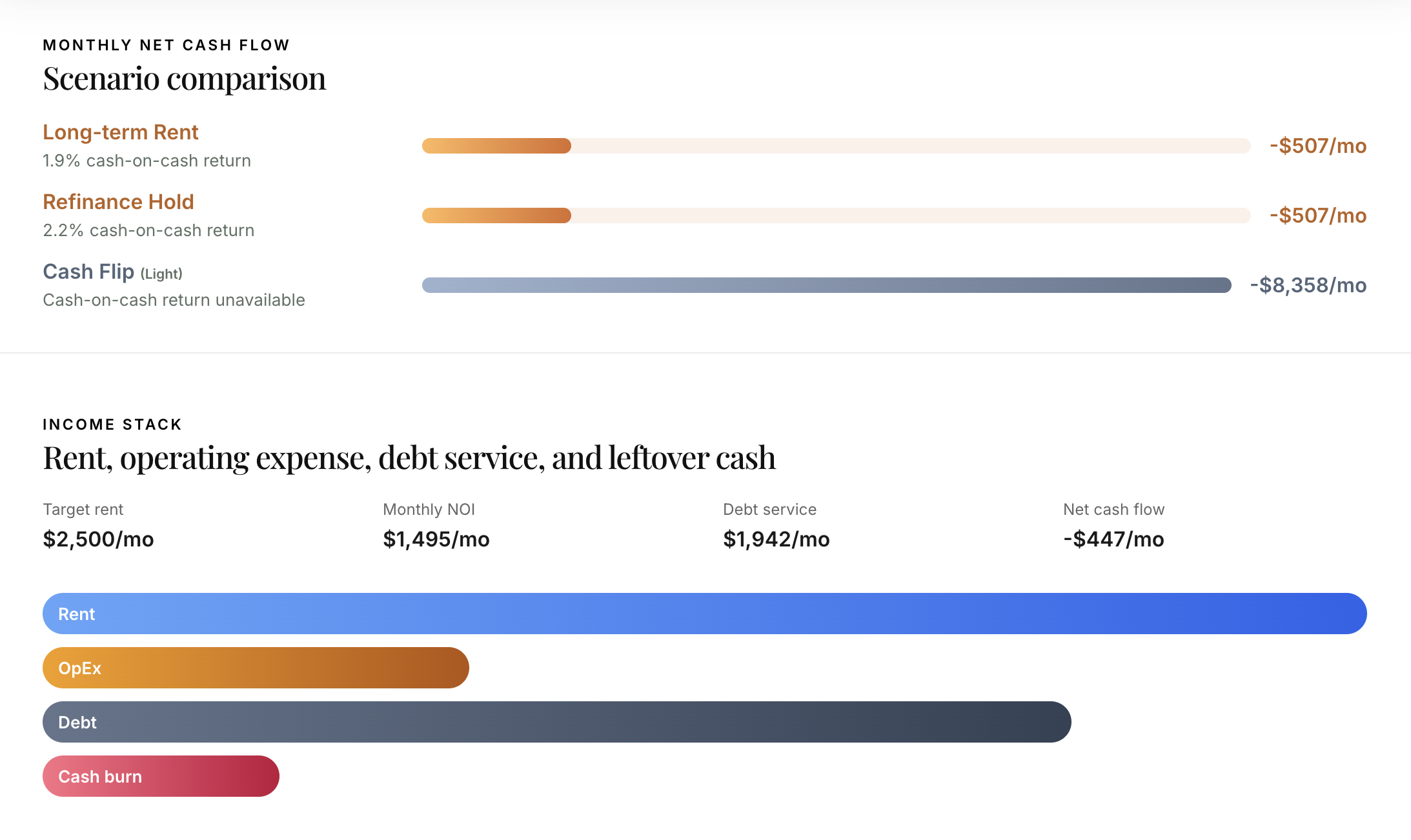
Cash Flow Stack
Monthly net cash flow, NOI, debt service, and burn are presented side by side so acquisition teams can understand the operating shape of a deal at a glance.
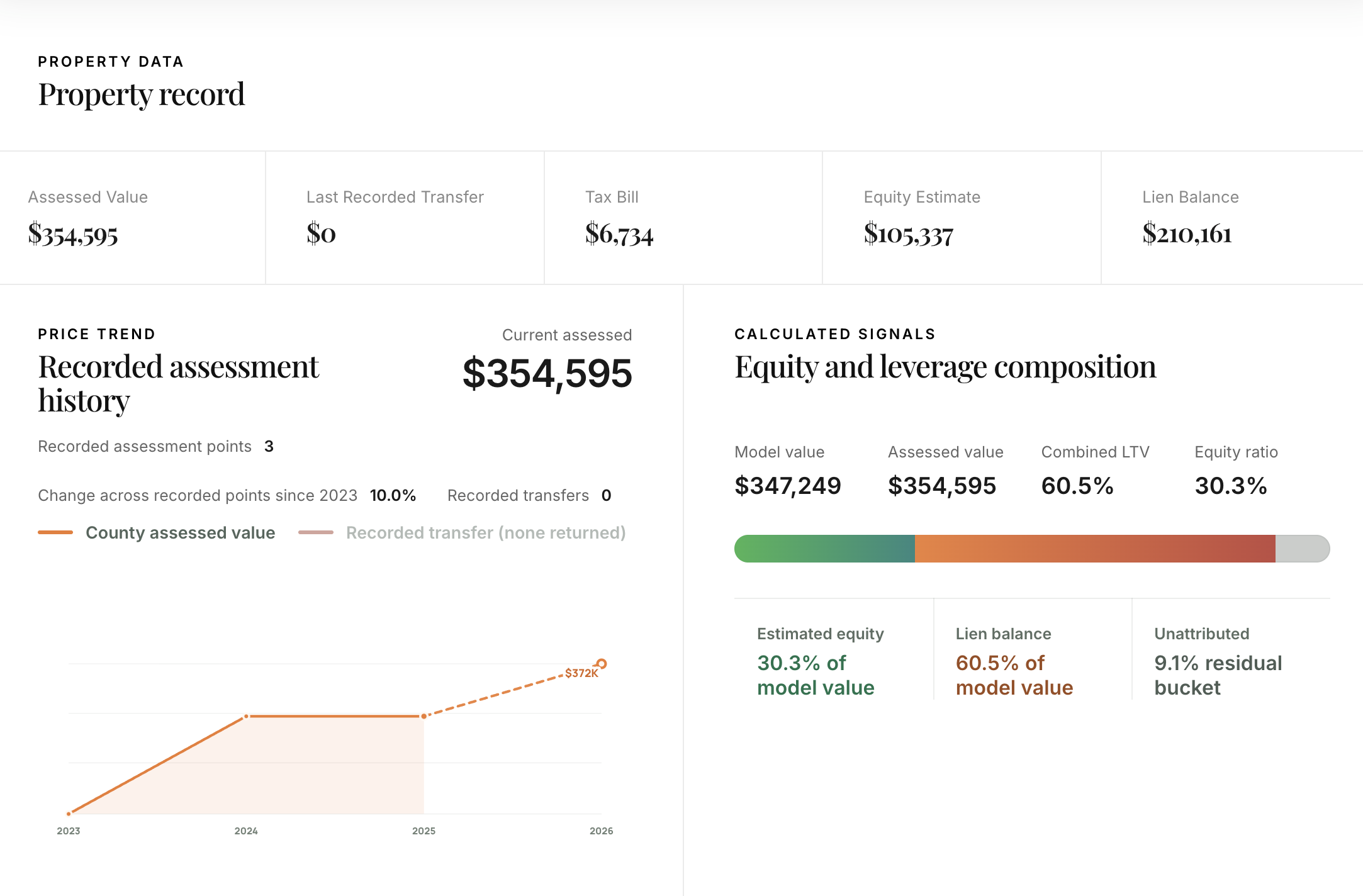
Property Record
The property record combines ownership and tax signals with calculated equity composition, giving lenders and investors a cleaner first-pass decision surface.
Why It Matters
Realtors
Prep owner, parcel, tax, transfer, and valuation context before client conversations.Investors
Move from address to equity, leverage, cash flow, and scenario judgment in minutes.Lenders
Check debt yield, DSCR, LTV, and risk thresholds before manual review.Acquisitions
Standardize first-pass property screening across thousands of address-level opportunities.Data Coverage
We extract, synthesize, and structure fragmented Austin, TX property data into institutional-grade underwriting signals for real estate investors and lenders.
Property Record
Risk Checks
Lender Screen
Market & History
Usage limit reached
You have used all available analyses for this billing cycle.